How AI improves website performance and SEO

Written by
Ankit Godara
Front End Developer

Vishal Chanda
Front End Developer

Table of contents
Build with Radial Code
Share this


Slow loading times and stagnant search rankings usually trace back to the same bottleneck: manual workflows. Engineering teams spend weeks manually tuning image formats, debugging Core Web Vitals, and writing structured data. Simultaneously, content managers struggle to map keyword intent across hundreds of pages without missing critical content gaps.
Artificial intelligence changes this dynamic. Instead of treating web performance and search engine optimization as separate reactive tasks, AI-driven platforms unify them. By combining predictive asset delivery with semantic search clustering, teams can automate technical site optimization while building pages that align directly with user intent.
This article details how modern development and marketing teams use AI platforms, automated workflows, and smart CMS integrations to deliver faster page speeds and higher search visibility. For a deeper look at measuring speed gains, see our guide on Measuring Your Website's Performance: Key Metrics and Tools for Success.
What AI-driven web performance and SEO actually means
To get real value from AI, it helps to look past generic content generation tools. In professional web workflows, AI operates across two core layers:
- Infrastructure and performance automation: Machine learning models analyze real-user monitoring (RUM) data to predict traffic spikes, optimize image compression dynamically, prefetch asset bundles based on user navigation behavior, and adjust cache headers at the edge.
- Semantic SEO and content architecture: AI platforms analyze search engine result pages (SERPs) using natural language processing (NLP) and vector embeddings. They cluster keywords by search intent, detect topical gaps across your domain, and generate valid Schema.org structured data programmatically.
When these two systems work together, search engines receive clear technical signals: fast loading times, clean structured data, and high-relevance content organized around distinct user queries. For a practical walkthrough on combining design and SEO from the start, read How to Integrate SEO Best Practices into Your Website Design.
Smart performance optimization: fixing core web vitals with AI
Page speed remains a confirmed Google ranking signal and a crucial driver of user conversion rates. Google recommends achieving good Core Web Vitals for success with Search and for providing a good user experience. If you want to compare the leading audit tools, check out Lighthouse VS Google PageSpeed Insights.
Traditional optimization relies on static rules—like setting blanket caching policies or manually converting images to WebP. AI introduces context-aware performance tuning.
Automated asset compression and edge delivery
Modern edge networks use AI models to evaluate visitor context—device type, viewport size, connection speed, and browser capabilities—in real time. The edge server dynamically compresses images, converts files to AVIF or WebP, and strips unnecessary metadata before serving the payload.
Predictive prefetching and resource loading
Static prefetching often wastes bandwidth by downloading resources a user never requests. AI-driven prefetching tracks user cursor movements, scrolling behavior, and historical navigation patterns to predict which page a visitor will click next. The browser prefetches only the required JavaScript chunks and API responses, reducing Interaction to Next Paint (INP) and Largest Contentful Paint (LCP) delays.
Here is a practical Node.js utility demonstrating how an automated edge rule evaluates requests to serve optimized WebP assets with intelligent cache headers:
 // Edge utility script for smart image routing and caching headers
 import { parseHeader } from './utils/headers.js';
    export async function handleImageRequest(request, env, context) {
        const url = new URL(request.url);
        const acceptHeader = request.headers.get('Accept') || '';
        const userAgent = request.headers.get('User-Agent') || '';
        // Determine optimal format based on client capability
        const supportsAvif = acceptHeader.includes('image/avif');
        const supportsWebp = acceptHeader.includes('image/webp');
        let targetFormat = 'original';
        if (supportsAvif) {
            targetFormat = 'avif';
        } else if (supportsWebp) {
            targetFormat = 'webp';
        }
        // Construct target CDN cache key
        const cacheKey = new Request(${url.origin}${url.pathname}?format=${targetFormat}&q=80, request);
        const cache = caches.default;
        let response = await cache.match(cacheKey);
        if (!response) {
            // Request raw asset from storage bucket
            const originResponse = await fetch(request);
            // Pass asset through transform engine
            const transformedStream = await env.IMAGE_TRANSFORMER.process(originResponse.body, {
                format: targetFormat,
                quality: 80,
                stripMetadata: true
            });
            response = new Response(transformedStream, {
                headers: {
                    'Content-Type': image/${targetFormat},
                    'Cache-Control': 'public, max-age=31536000, immutable',
                    'Vary': 'Accept',
                    'X-AI-Optimized': 'true'
                }
            });
            context.waitUntil(cache.put(cacheKey, response.clone()));
        }
        return response;
    };
This code snippet removes manual image exporting from the developer workflow while ensuring visitors always receive the smallest viable file payload.

Elevating SEO through semantic intent and automated schemas
Keywords alone no longer guarantee search visibility. Search engines rely on semantic understanding, topic authority, and structured entity graphs. AI SEO platforms allow technical teams to scale content research and structured data without manual guesswork.
Intent clustering using vector embeddings
Instead of targeting isolated keywords, modern SEO strategies organize topics into clusters based on user search intent (informational, transactional, navigational). AI platforms process target keyword lists using text embedding models, grouping terms by semantic similarity.
The following Python script illustrates how to cluster keywords programmatically using cosine similarity over embeddings, allowing content teams to build comprehensive pillar pages:
import numpy as np
from sklearn.metrics.pairwise import cosine_similarity
from sentence_transformers import SentenceTransformer

// Load lightweight sentence embedding model
model = SentenceTransformer('all-MiniLM-L6-v2')

keywords = [
    "how to speed up web page load time",
    "optimize website performance for SEO",
    "best AI SEO tools for keyword research",
    "improve core web vitals LCP score",
    "AI platform for semantic content clustering",
    "reduce image file size automatically"
]

// Generate 384-dimensional vector embeddings
embeddings = model.encode(keywords)

// Compute pairwise cosine similarity matrix
similarity_matrix = cosine_similarity(embeddings)

// Group keywords with similarity score > 0.65 into clusters
threshold = 0.65
clusters = {}
visited = set()

for idx, kw in enumerate(keywords):
    if idx in visited:
        continue

    related_indices = np.where(similarity_matrix[idx] >= threshold)[0]
    cluster_group = [keywords[i] for i in related_indices]
    clusters[f"Cluster_{idx + 1}"] = cluster_group
    visited.update(related_indices)

for cluster_name, items in clusters.items():
    print(f"--- {cluster_name} ---")
    for item in items:
        print(f"  • {item}")
Running this script groups fragmented search terms into cohesive topic buckets, preventing keyword cannibalization across your domain.
Programmatic Schema.org markup generation
Search engines require structured data (JSON-LD) to understand entity relationships on a page. Manually writing schema for thousands of products or articles often leads to syntax errors or missing required attributes. AI tools inspect page content, extract entities, author credentials, and published timestamps, and output clean JSON-LD markup automatically.
{
  "@context": "https://schema.org",
  "@type": "TechArticle",
  "headline": "How AI Can Improve Website Performance and SEO",
  "description": "A comprehensive guide on leveraging AI tools for Core Web Vitals, asset compression, and semantic search optimization.",
  "articleSection": "AI & Technology",
  "inLanguage": "en-US",
  "author": {
    "@type": "Organization",
    "name": "Engineering Content Team"
  },
  "publisher": {
    "@type": "Organization",
    "name": "Web Performance Hub",
    "logo": {
      "@type": "ImageObject",
      "url": "https://example.com/assets/logo.png"
    }
  },
  "mainEntityOfPage": {
    "@type": "WebPage",
    "@id": "https://example.com/blogs/how-ai-can-improve-website-performance-and-seo"
  }
}
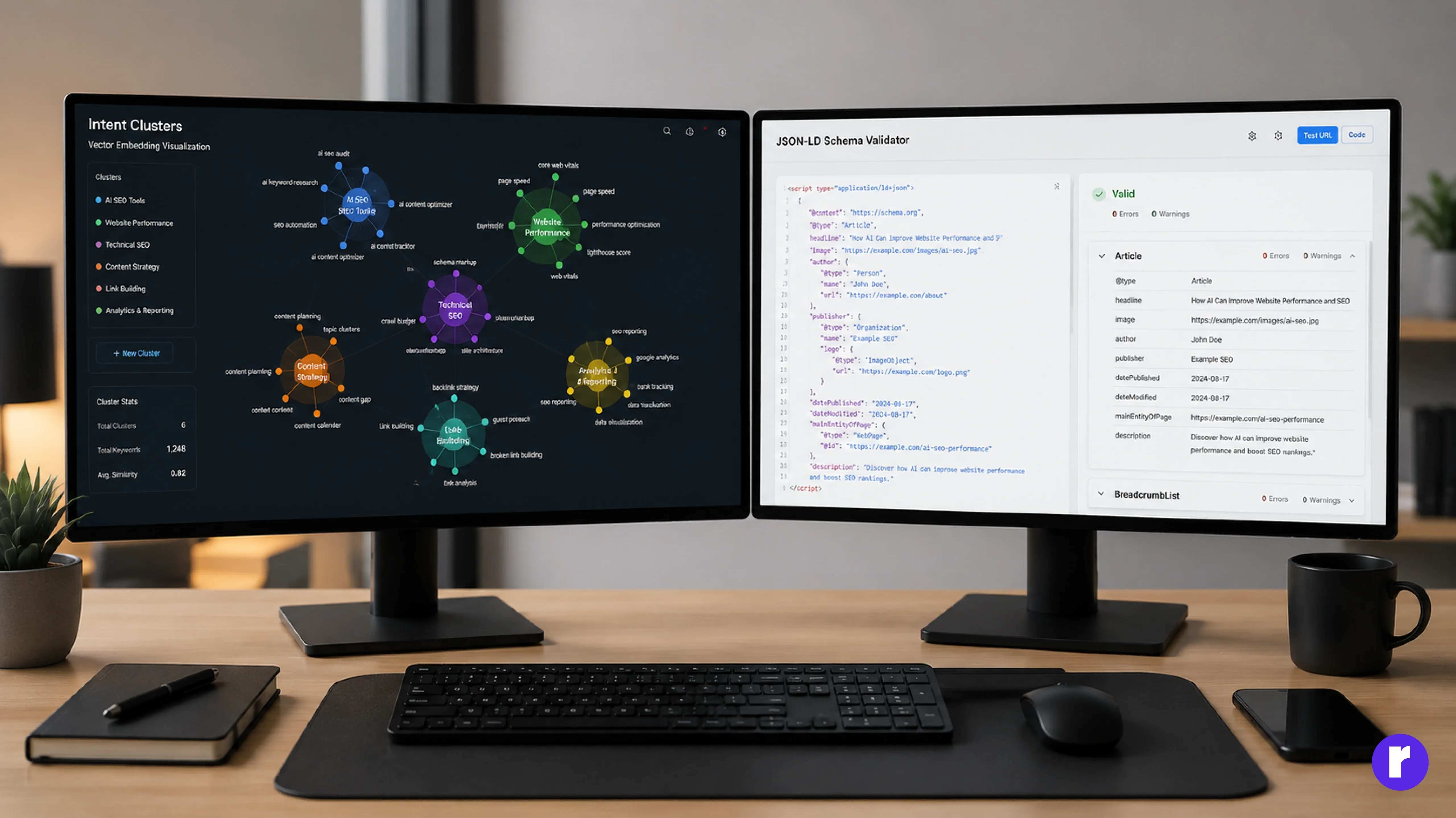
Modern AI tech stack and CMS integration workflow
To build an efficient pipeline, teams combine specialized AI platforms with existing CMS and frontend setups.
|
Task Category |
AI Tool / Technology |
Primary Benefit |
|---|---|---|
|
Asset Optimization |
Cloudflare Workers AI, Cloudinary AI |
Automatic format selection, responsive resizing, zero manual export |
|
SEO Audit & Clustering |
Ahrefs, SurferSEO, Custom Python Embeddings |
Identifies content gaps, maps intent, avoids cannibalization |
|
Schema & Metadata |
Programmatic JSON-LD generators |
Validates structured data, updates entity tags automatically |
|
Core Web Vitals RUM |
Pinpoints exact code blocks causing LCP, INP, and CLS issues |
Pinpoints exact code blocks causing LCP, INP, and CLS issues |
WebPageTest is now integrated into Catchpoint's performance platform, while webpagetest.org continues as the open-source and community hub.
Integrating these tools into a headless CMS (such as Contentful, Strapi, or WordPress via GraphQL) allows content creators to publish optimized pages while automated background scripts validate SEO markup and compress assets prior to build deployment.
Tip: Set up automated CI/CD checks using Lighthouse CLI and AI audit scripts. If a pull request degrades Core Web Vitals scores or missing mandatory meta tags, block the build before it reaches production.
Common mistakes when using AI for performance and SEO
While AI offers significant advantages, unmonitored automation can harm your site performance and organic rankings.
- Publishing unedited AI content: Search engines prioritize unique, authoritative content written with experience and expertise (E-E-A-T). Relying on raw AI output leads to repetitive phrasing and inaccurate technical claims.
- Adding heavy client-side AI scripts: Loading bulky third-party JavaScript widgets for real-time AI recommendations often ruins your INP and Total Blocking Time (TBT) metrics. Keep AI processing at the edge or server level.
- Ignoring canonical URL mappings: Automated content generation tools can accidentally create duplicate landing pages. Always enforce strict canonical tags.
Important: Always run human editorial reviews on AI-generated text and schema markup. AI can hallucinate syntax attributes or misinterpret niche industry terminology. Continue your learning journey at a class="link-text" href="https://learn.radialcode.com/?utm_source=radialcode" target="_blank" rel="noopener">Radial code
Best practices for implementation
- Process assets on the server or edge: Perform image compression, HTML minification, and schema generation server-side to keep client JavaScript bundles lightweight.
- Audit internal linking structure: Use NLP to analyze your existing page library and auto-suggest contextually relevant internal links to boost domain authority distribution.
- Monitor Core Web Vitals continuously: Track real-user metrics before and after deploying AI performance tools to confirm measurable gains in LCP and INP scores.
Conclusion
Artificial intelligence transforms web performance and SEO from manual tasks into an integrated, automated system. By using AI for asset optimization, resource loading, semantic keyword clustering, and structured data, teams can improve website performance while creating content that better aligns with user intent.
Start small by automating image optimization and schema generation, then gradually incorporate semantic keyword clustering and continuous Core Web Vitals monitoring into your workflow.