The Starting Journey of a Designer: From Curiosity to Creation

Written by

Priyanka Jangra
UI/UX Designer
Table of contents
Build with Radial Code
Share this


Every great designer starts with a single, unstoppable spark.
It's that moment when curiosity turns into an urge to create. Maybe you spent hours doodling, felt a strange satisfaction rearranging colors, or whispered, "Damn, someone designed this" while admiring a clean app screen or a perfectly symmetrical logo.
That's the shift. That’s your first step, not into design software, but into the designer’s mindset.
You begin noticing how colors balance emotions, how typography sets a mood, and how layout quietly guides your eyes. Without realizing it, you’ve already taken your first step, not into design software, but into the designer’s mindset.
The Spark of Curiosity
Design doesn’t make a grand entrance. It sneaks in, disguised as curiosity. Maybe it’s that strange satisfaction when you adjust the spacing between words. You start noticing the invisible architecture of the world around you:
- How typography sets a mood.
- How colors balance emotions.
- How a layout quietly guides your eye.

This wonder quickly leads to questions:
- “Why does this logo feel so powerful?”
- “How do colors make people feel different emotions?”
- “Why do some apps feel so easy to use?”
This curiosity is your fuel. Never let it fade. Read more about this.
Learning the Fundamentals
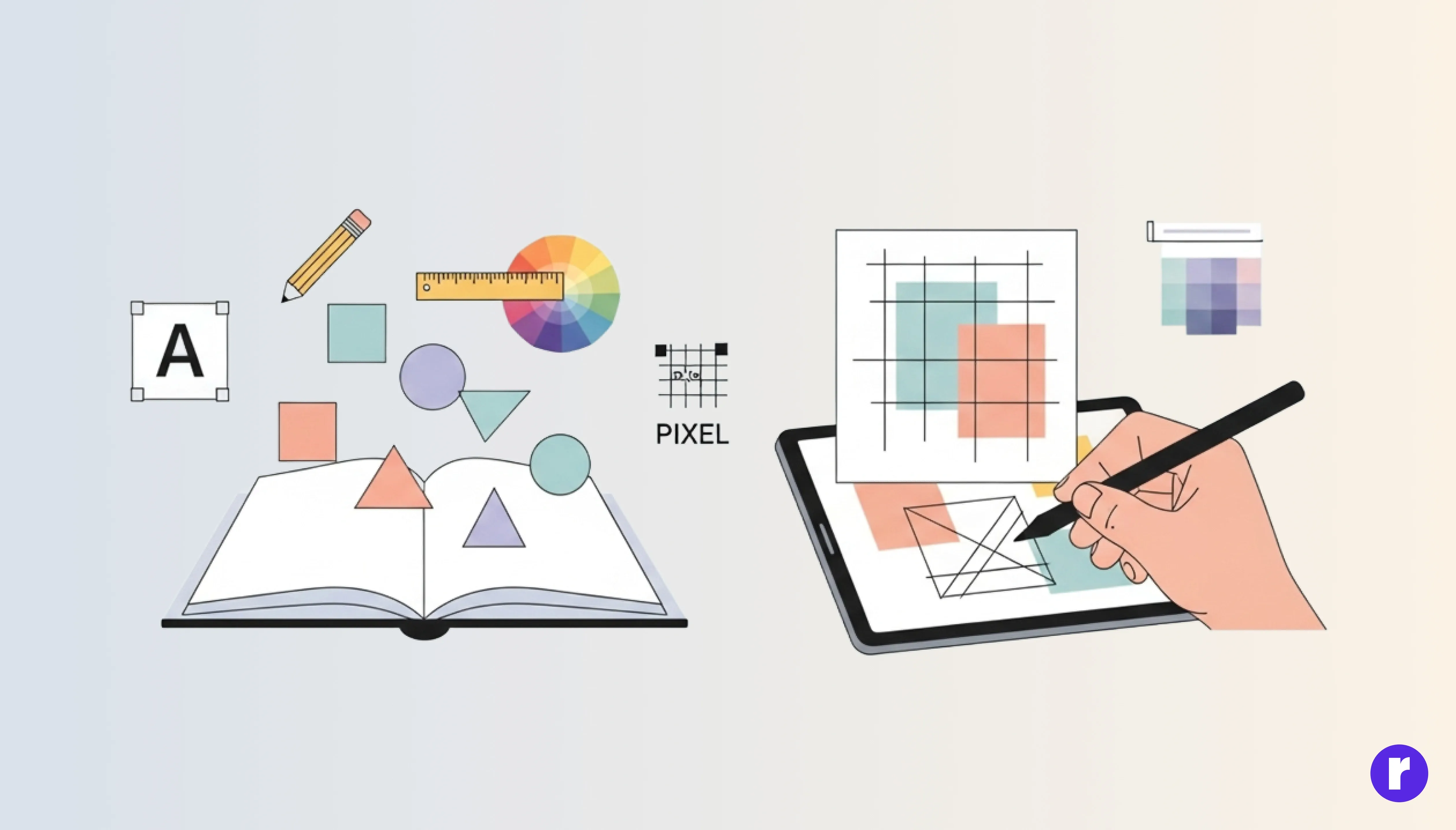
Curiosity soon leads to exploration. You start experimenting — learning tools like Adobe Photoshop , Illustrator or Figma diving into typography, color theory, and layout design. But here's the crucial truth: Tools don't make the designer, thinking does.
The real growth happens when you learn the "why" behind every creative choice:
- Why does balance matter?
- Why does whitespace breathe life into a design?
- Why is less often more?
This phase is about building a foundation not just in skill, but in intentionality.
The Struggle of Practice

Every designer remembers the struggle — the messy artboards, the endless revisions, the designs that looked better in their head.
But this struggle is sacred. It’s where you learn resilience, iteration, and the importance of feedback.
As the saying goes: “Your first 100 designs won’t be your best, but they’ll be the reason you get better.”
The gap between what you imagine and what you create slowly closes. Mistakes turn into lessons. Frustration turns into confidence.
Discovering Your Style
After enough experimentation and struggle, you begin to find your voice.
- Do you love clean minimalism?
- Do you thrive on vibrant, illustrative visuals?
- Is your focus on UX simplicity?
This is the phase of self-discovery—understanding what excites you and what you want your work to say. Your design style becomes your signature—the unique rhythm that defines your creative fingerprint. Read more about this.
From Learner to Creator
Over time, something changes — you stop following tutorials and start making your own. You design not just to practice, but to express and solve real problems.
You start collaborating, building portfolios, taking on clients, and turning creativity into a craft. Every new project becomes a chance to tell a story — to design with intention and impact.
You begin seeing your work and the world as inseparable. Every design choice carries intention, and every observation outside your canvas feeds back into your creations.

Conclusion
The journey from curiosity to creation is an ongoing evolution. You stop following tutorials and start making your own. Design trends will change, tools will upgrade, but the creative spark that started it all never fades. The best designers never stop learning.
Remember this: Every great designer was once a beginner who dared to start.
Keep asking questions. Keep experimenting. Keep creating.
Design isn't just what you make—it's how you see the world, one curious step at a time.
Ready to take your design skills to the next level? Discover tips, tutorials, and inspiration on our website! Visit Here